
Koyaanisqatsi, rebuilt as a living AI obelisk.
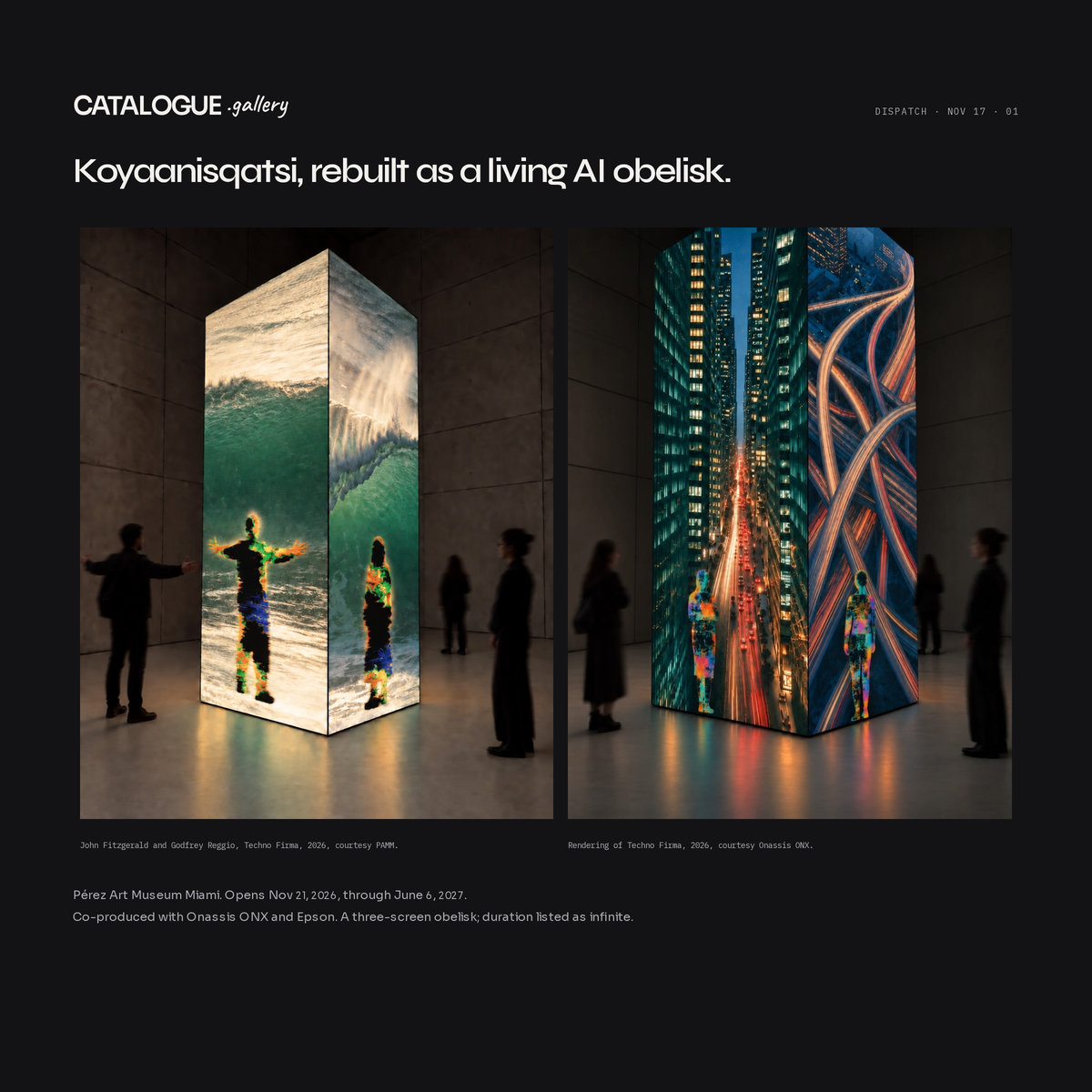
On Saturday the Pérez Art Museum Miami (@pamm) switches on Techno Firma by John Fitzgerald and Godfrey Reggio, the museum's first artist-driven AI exhibition, timed to Miami Art Week and on view through June 6, 2027. Fitzgerald trained a custom machine learning model on the Reggio Foundation Archive, and across a three-screen obelisk it generates oceans, forests, highways and factory lines in real time. Computer vision reads the room: as visitors gather, the imagery speeds up and fractures. Co-produced with Onassis ONX and Epson, the work's duration is listed as infinite. Reggio talks with Hans Ulrich Obrist on Nov 30.
New on catalogue.gallery: the chips inside the body.
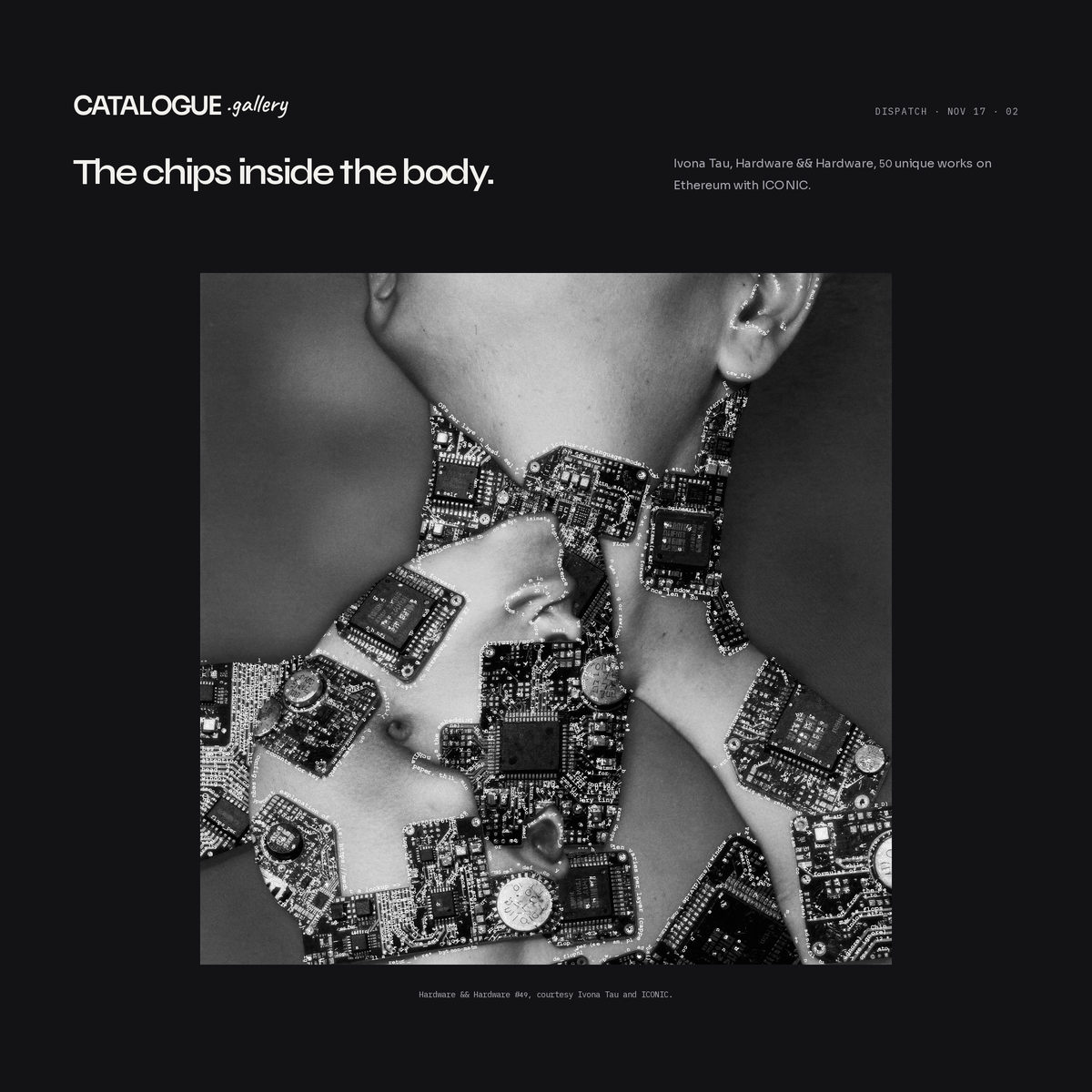
In Hardware && Hardware, 50 unique works on Ethereum with ICONIC (@iconic__culture), Ivona Tau (@ivonatau) collages the microprocessors AI runs on into bodies shaped by her own models, each chip overlaid with source code from Andrej Karpathy's nanochat. There are no prompts: she trains on small datasets of her black and white photographs and her family archive, and stops each image before it turns realistic. "A model can never know what it runs on," she says. The && is the logical AND: one hardware is the computer, the other the body. Anne Spalter (@annespalter) and Michael Spalter are among its collectors.
New on catalogue.gallery: a copy of a copy, $7.9 million.
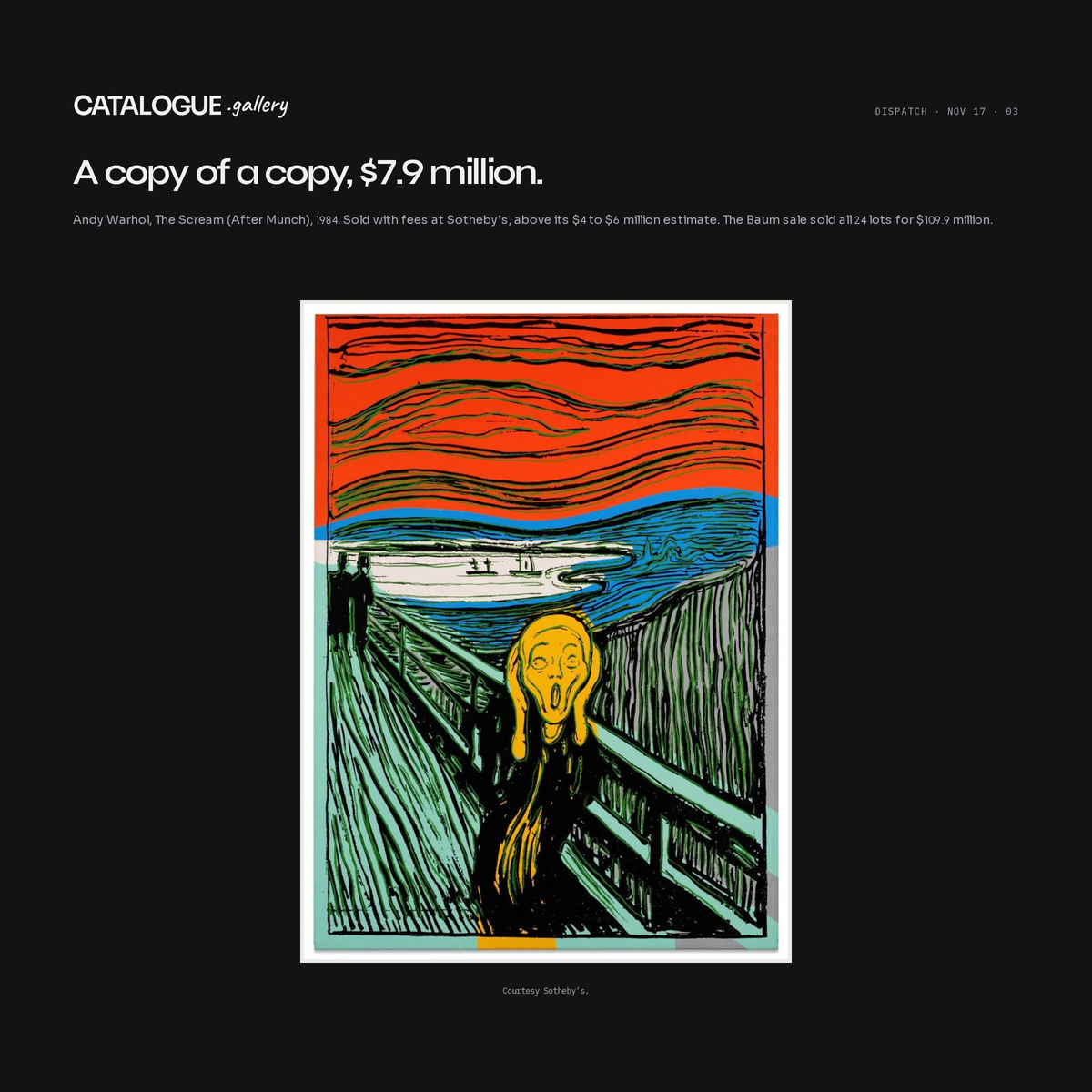
Andy Warhol's The Scream (After Munch) (1984) sold for $7.9 million with fees at Sotheby's (@Sothebys) last night, above its $4 to $6 million estimate, as the Baum collection sale opened New York's November auctions, The Art Newspaper reports. Warhol worked from Munch's lithograph, not the painting, choosing the version that was already a reproduction and pushing it one step further into Pop. The Baum sale sold all 24 lots for $109.9 million.
Runway archives you have to walk, wait or answer for.
Hussein Chalayan and the spatial computing platform ZOME release three digital capsules tomorrow, pairing runway films from his landmark collections with new texts he wrote looking back on them. Each opens only under its own condition: one after the viewer travels a set number of steps, one after six months with no shortcut, one after the right answer to a question Chalayan poses. The capsules are anchored where the shows first took place, including Sadler's Wells in London and Théâtre de Paris.
Frieze lands in the Gulf.
The first Frieze Abu Dhabi previews Thursday at Manarat Al Saadiyat, with public days Nov 20 to 22, replacing Abu Dhabi Art after 17 years. Directed by Dyala Nusseibeh, it brings more than 80 galleries from 36 countries and territories. Lebanese artist Dala Nasser, first winner of the Frieze Abu Dhabi Artist Award, fills the atrium with Qubbat Duris, and Frieze Sculpture puts four artists on Mamsha Beach through Dec 16.