
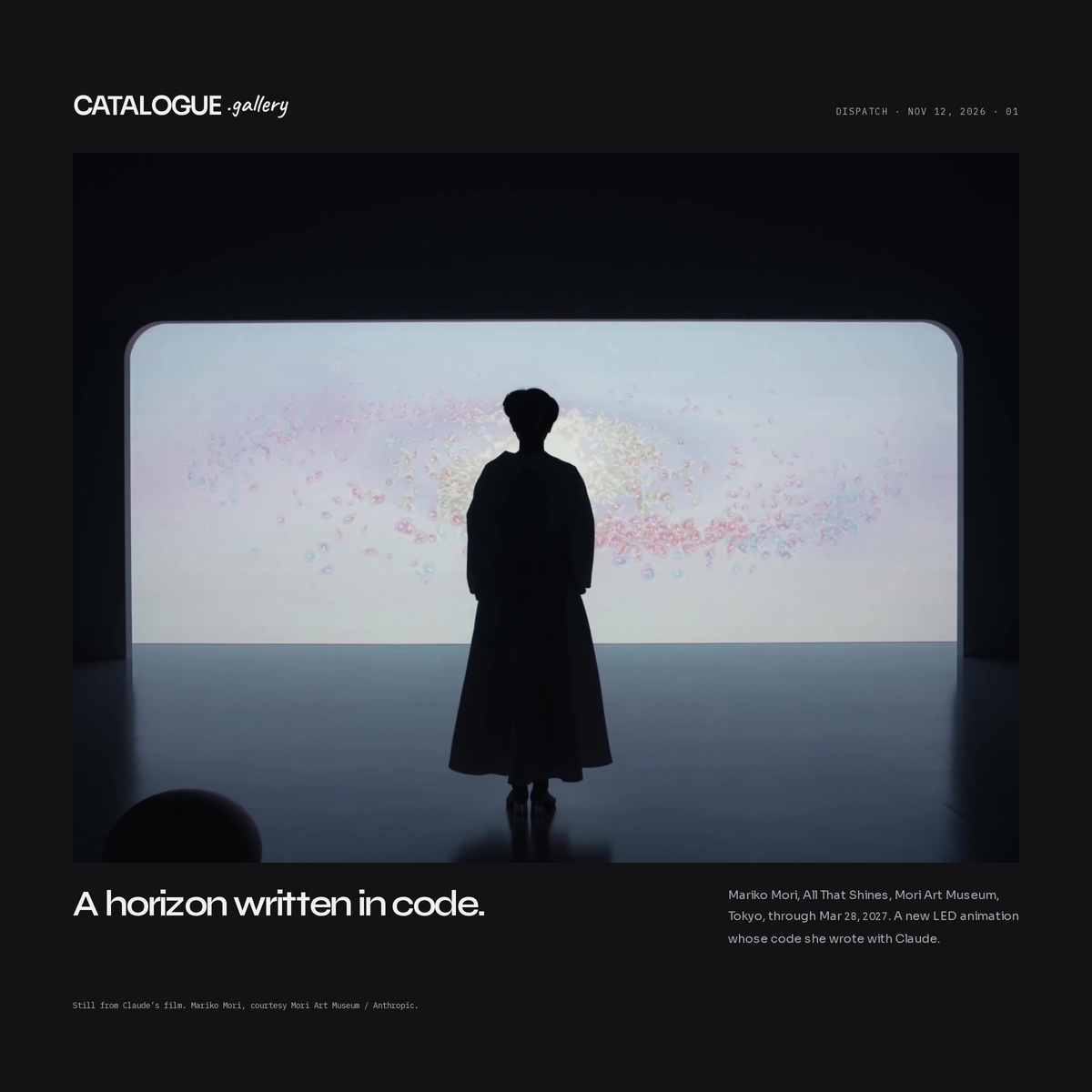
A horizon written in code.
Mariko Mori has pushed art toward technology for three decades, from her 1990s cyborg photographs to Wave UFO, which turned visitors' brain waves into images. For her retrospective All That Shines at the Mori Art Museum (@mori_art_museum) in Tokyo, about 40 works organised with the Guggenheim (@Guggenheim), she used Claude (@claudeai) to write the code for a new computer-generated animation: a horizon opening onto radiant light, shown on a large LED screen. Anthropic (@AnthropicAI) is a partner of the show, and Claude's account posted a short film on the work overnight, in which Mori says she does not see technology and spirituality as opposites. Through Mar 28, 2027.
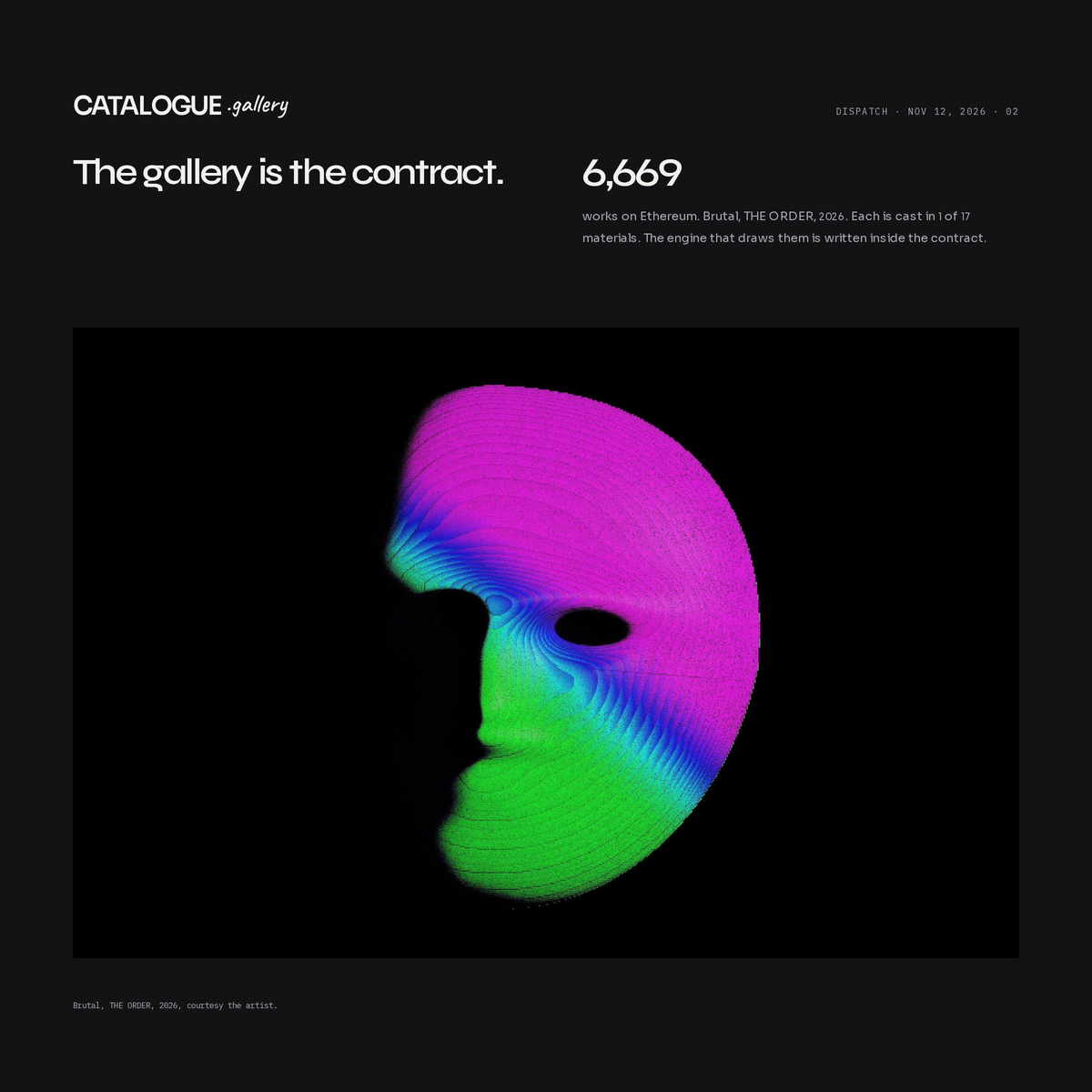
New on catalogue.gallery: the gallery is the contract.
Brutal (@BrutalS81) opened THE ORDER on Ethereum yesterday: 6,669 generative works that begin as still faces, lie down into moving landscapes and stretch their own frame from square to 16:9 as they run. Each is cast in 1 of 17 materials, ranked from gold down to graphite. The engine that draws them is not on a server or IPFS but written inside the contract, so anyone can call it and the work runs. "A painting has the shape it has. Always has. My code doesn't know that rule," Brutal wrote.
Reverspective goes generative.
FungibullX (@FungibullX), a new platform powered by ElmonX (@elmonx_official) that wants digital art to feel more like an auction house than a marketplace, opened its first sale with Patrick Hughes, the British painter who invented reverspective. Two of his prints become 100-work generative sets: Sunshine (1974), where only the light in a bare room changes, from full day to deep night, and Colour Process (1984), a rainbow pouring through a home computer, now with 78 animated works and one that responds to the viewer. The ranked auctions close today.
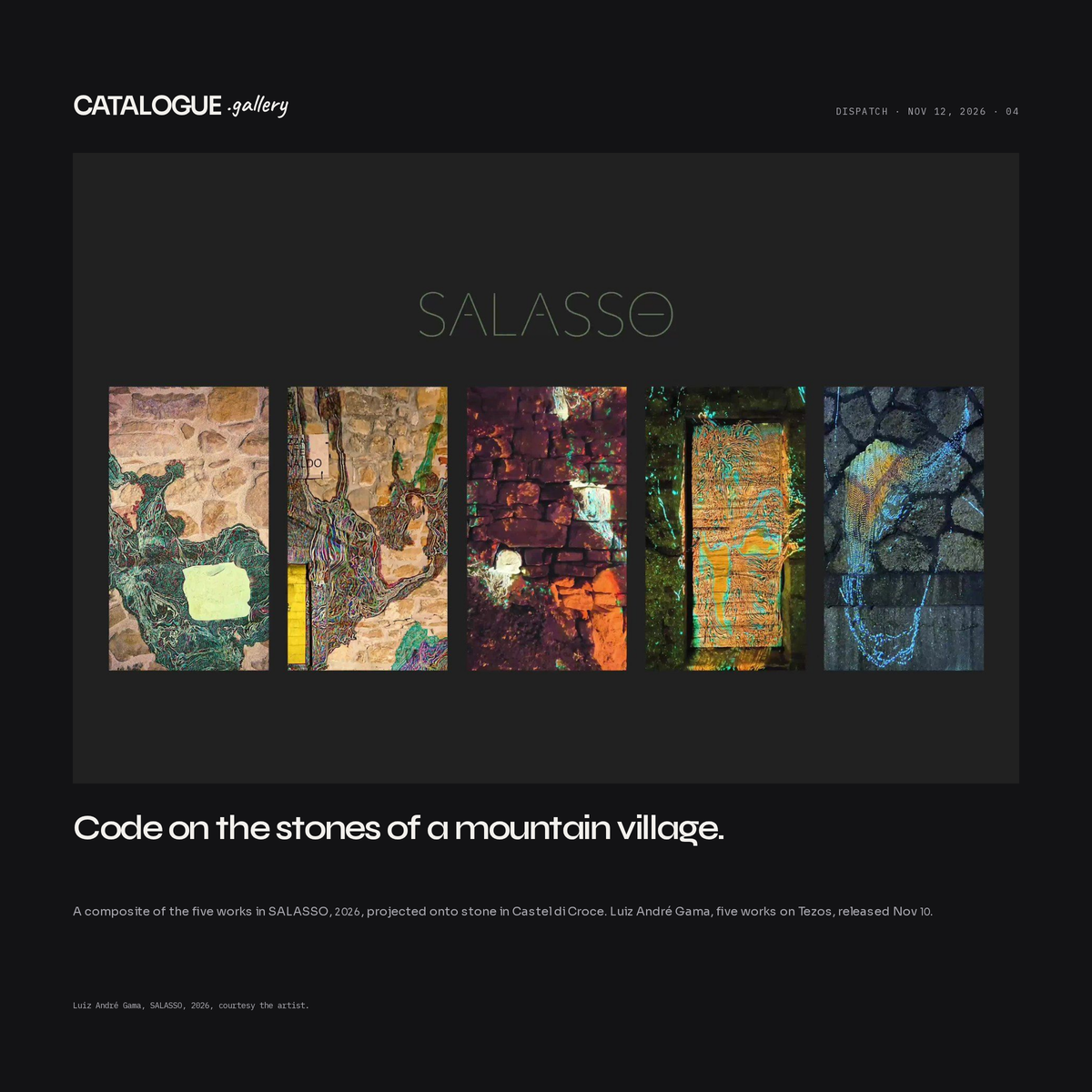
New on catalogue.gallery: code on the stones of a mountain village.
Over five months, Luiz André Gama (@luizandregama) worked through long nights in Castel di Croce, a shrinking village high in Italy's Monti Sibillini, projecting generative work made in TouchDesigner onto its walls, doorways and fountain. SALASSO, Italian for bloodletting, turns those nights into five short works on Tezos, released on objkt (@objktcom) on Nov 10. It is one part of a wider project to bring the village back to life through art.
New on catalogue.gallery: a painting named for a poet.
Joan Mitchell painted Green Book of Barbara Guest around 1960 in Paris, at the start of her most celebrated period, and named it for her friend, the poet and critic. Kept in her own collection and then four decades with Theodore and Ruth Baum, it has not been seen in public for 60 years. It comes to auction for the first time in Sotheby's (@Sothebys) Baum evening sale in New York on Nov 16 at $12 to 18 million, on view on Madison Avenue through Nov 15.